Document
Document
File Name
SDDEL 2.PDFFile Type
PDF DocumentFile Size
965 kBCreated Date
2024 Sep 10Updated Date
2024 Sep 10Published on
2024 Sep 10Countries

Niger
Thematic Areas
Agricultural BiodiversityGenetic Use Restriction TechnologiesClearing-House MechanismsSUSTAINABLE LIVESTOCK DEVELOPMENT STRATEGY (SDDEL 2013-2035)
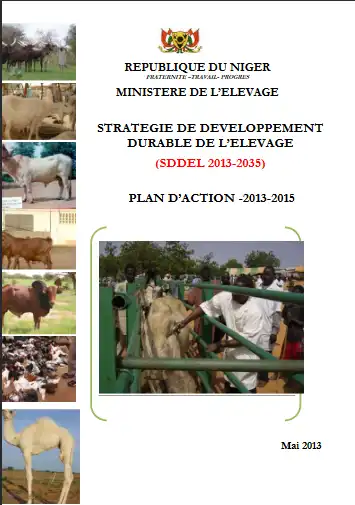
The Ministry in charge of Livestock has designed a strategy covering the period (2013-2035), including policy perspectives in order to better exploit animal potential, i.e. to improve the health of its livestock, its level of production and the valorization of its productions, both in quantity and quality. Moreover, the integration of Niger into sub-regional groups (ECOWAS, UEMOA) involves concerted actions in terms of transhumance, animal health
control and taxation. In addition, integration requires a certain harmonization of the presentation of investment budgets. The action plan takes into account these various imperatives.
The issues and challenges of breeding are multifaceted and generally fairly well known. The mobilization of all actors in the development of livestock (producers and their representatives, intermediate actors in the sectors, exporting traders) must be effective in order to initiate the desired change during this first stage. Taking into account the current directives, this action plan prioritizes the security of production systems with a view to a significant and rapid
increase in animal production in the short term (2013-2015) and for its implementation, three strategic axes are selected. First of all, it is a question of improving animal health and guaranteeing the quality of food and products from livestock. To do this, strengthening the capacity of the Ministry and its branches in their public service mission must be coupled with a lasting partnership with private veterinarians and other actors who contribute to animal health (research institutions, for example). Progressively, Niger must meet international animal health standards, according to the shared
guidelines of the International Organization for Animal Health. It is then a question of ensuring consistent animal production and the correct valorization of products. This axis favors the sustainable management of pastoral areas so that access to natural resources (pastures and water) is secure. It must also support the modernization of family farms as well as support the marketing of products in order to provide better remuneration for producers. The development of poultry and dairy farms is also envisaged near urban centers. The control of the processing of animal production and access to agro-industrial by-products must make it possible to secure national livestock and production units in the process of intensification.
The third axis concerns the management and governance of the Department. Given the complexity of its mission and its central position in relation to the various networks of actors, the Ministry must improve its organization. This requires better management of human resources (recruitment, career plans, training), optimal allocation of working resources (logistics, equipment, fuel, supplies and consumables, etc.), effective internal and external communication, and results-based management. Nineteen products and 53 activities are defined and need to be developed. Synergy through good governance must be effective in order to implement the action plan for this first stage (2013-2015) focused on the productive capacities of the various livestock farming methods. In short, once adopted, the SDDE will be implemented according to this plan structured in two main parts: (i) the operational strategic guidelines and (ii) the implementation and monitoring-evaluation system.
Published on
2024 Sep 10Countries
Niger