Document
Document
File Name
PLAN FORESTIER NATIONAL NIGER 2012-2021.pdfFile Type
PDF DocumentFile Size
1.72 MBCreated Date
2024 Sep 11Updated Date
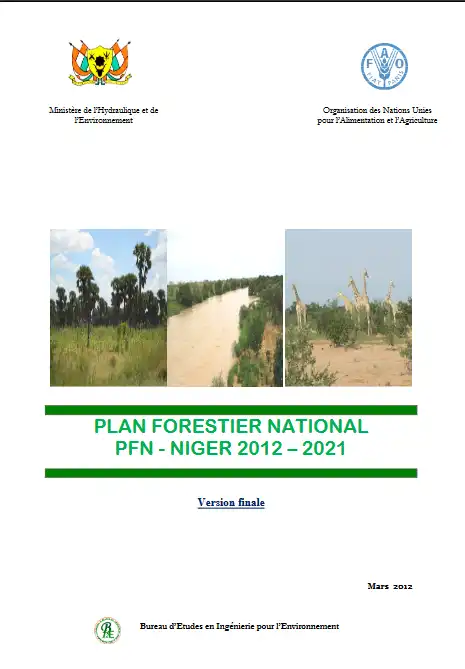
2024 Sep 11NATIONAL FOREST PLAN NFP - NIGER 2012 — 2021
A Sahelian and totally landlocked country, Niger has an economy essentially based on the primary sector and whose productive rural activities have been put to the test for decades by recurrent droughts, land degradation and desertification.
However, despite their limited potential, due to the multiple services they offer to numerous communities, the country's forest resources continue to play an important role in improving food security and are still the main source of energy for more than 90% of Nigerien households with a monetary value of around 105 billion CFA francs.
Therefore, in order to strengthen the ecological and socio-economic position of the forest sector, our country has undertaken since 1991, with the support of FAO, to draw up a sectoral forest development programme. It is with this in mind that the Nigerien authorities, by adhering to the initiative, included the development of the first National Forest Plan (NFP) in Law 2004-040 of 8 June 2004 establishing the forest regime. Globally, the PFN-Niger aims to promote the conservation and sustainable use of forest resources in order to meet local and national needs, through the strengthening of partnerships in the management, protection and rehabilitation of forest resources and land.
Therefore, far from being another exercise, the National Forest Plan process aims to translate into the operational level, for the period 2012-2021, the orientations, strategic axes and programs of the Rural Development Strategy (SDR) in terms of forest development. Naturally, the NFP is perfectly in line with the objectives of the Accelerated Development and Poverty Reduction Strategy (SDRP) and also contributes to the achievement of the objectives of the 3N Initiative the “Nigeriens Feed the Nigeriens” of the President of the Republic who wants our agro-sylvo-pastoral production systems to transcend these hazards.
This document, built around the SDR, while being a document for advocacy and resource mobilization, constitutes for my country the reference framework for the implementation of forest management actions for the next ten years. Therefore, I would like to hope that all our development partners, in particular FAO, will continue with us the efforts already begun in a fruitful and lasting partnership for the implementation of this important, ambitious and realistic forest
development tool for Niger.